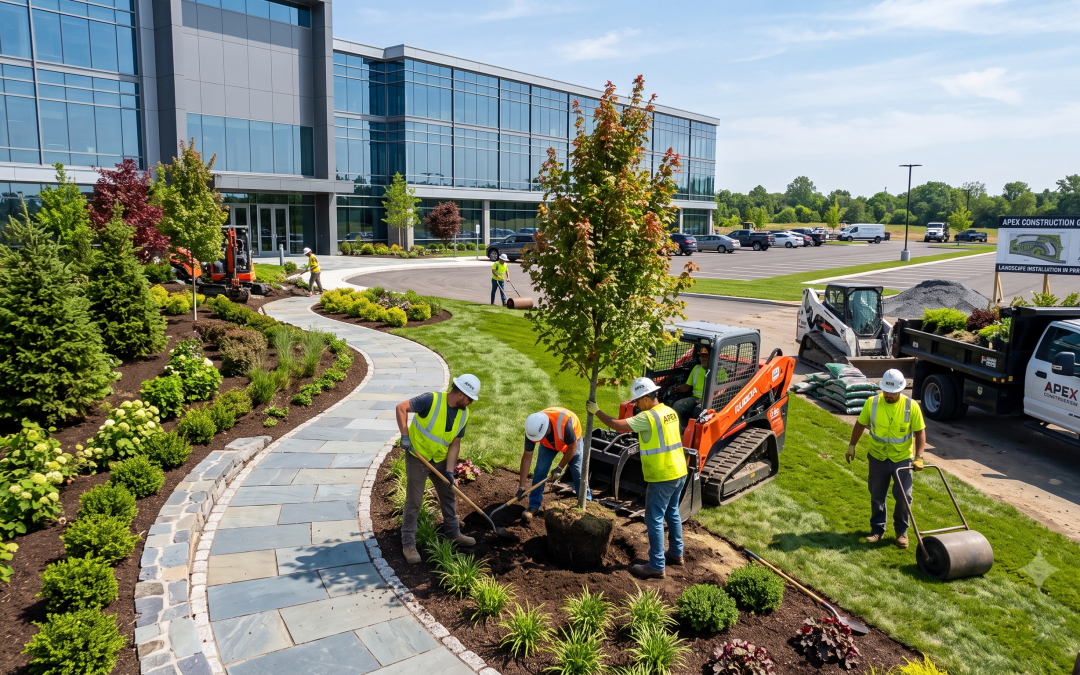
Commercial landscape installation should be planned at the site design stage, not bid out three weeks before certificate of occupancy. The sequence that works is: confirm the landscape ordinance requirements for your municipality, plan grading and drainage with the civil work, rough in irrigation sleeving before paving, install trees and large material before final grading of turf areas, then finish with beds, mulch, and sod. Properties that follow that order finish on time. Properties that treat landscaping as a punch list item pay twice, once to install and once to fix what the other trades damaged.
Key takeaways
- Landscape ordinance compliance is a permitting issue in most Northwest Arkansas municipalities. Find out early what tree counts, buffer widths, and parking lot island requirements apply.
- Sleeving under pavement costs almost nothing before the concrete is poured and a great deal afterward.
- Northwest Arkansas clay drains poorly. Budget for soil amendment and drainage rather than hoping.
- Plan the maintenance contract at the same time as the installation. Establishment is the fragile period.
Why landscaping gets squeezed at the end
On most commercial builds, landscaping is one of the last line items to be contracted and one of the first to absorb budget pressure when the project runs over. That happens for understandable reasons. It is visible, it is discretionary compared to structural work, and it feels like something that can be scaled back without consequence.
The problem is that the decisions that determine landscape cost are made much earlier, during grading and site utilities. By the time the landscape contractor arrives, the site has already been shaped in a way that either helps or hurts.
Northwest Arkansas is in an active building cycle. Springdale alone has major mixed use development in progress, and commercial space keeps coming online across the Springdale, Rogers, and Bentonville corridor. That means a lot of new sites are going through this exact sequence right now.
Phase one: requirements and design
Check the ordinance first. Municipalities across Washington and Benton County have landscape requirements that vary by zoning and use. Typical items include minimum tree counts per parking space, interior parking lot island area, street frontage buffer plantings, and screening for dumpsters and mechanical equipment. Some also require irrigation for required plantings. Getting a plan rejected at review is an avoidable delay.
Design to the site, not to a stock plan. A west facing entry with reflected heat off pavement is a different environment from a shaded north side. Sun exposure, wind, and soil conditions vary considerably even within one property, especially on the rolling terrain common in the Ozarks.
Decide the maintenance standard now. A design that requires four color rotations and weekly hand pruning will look bad within a year if the eventual maintenance budget supports two visits a month. Design and maintenance budget need to agree.
Phase two: grading, drainage, and soil
This is where money is made or lost.
Much of Northwest Arkansas sits on red clay over limestone and sandstone. It is fertile and it holds water. On a graded commercial site, heavy equipment compacts that clay into something close to pavement. Planting into compacted clay without amendment is the single most common cause of commercial plant failure here.
Practical steps:
- Preserve topsoil during grading if the site plan allows, and stockpile it for reuse rather than hauling it off and buying it back.
- Break compaction in planting areas before installation, not after.
- Amend beds properly. Organic matter improves both drainage and moisture retention in clay.
- Solve water routing on paper. Downspouts, curb cuts, roof drains, and parking lot flow all end up somewhere. If that somewhere is a planting bed, the plants will not survive.
- Consider structural soil or raised planters in tight parking islands where compaction is unavoidable.
Phase three: irrigation
For a fuller treatment of design, zoning, and service, see our guide to commercial irrigation systems in Northwest Arkansas. The installation-stage essentials are below.
Sleeve under every pavement crossing before paving. This is the cheapest insurance on the entire project. Once curbs and asphalt are in, adding a crossing means boring or saw cutting, and both are expensive.
Design the system with real zones. Turf and shrub beds have different water needs and should not share a valve. Drip or low volume irrigation in beds uses less water and keeps foliage dry, which reduces disease pressure in our humid summers.
Include a controller with seasonal adjustment and a rain sensor. A commercial site running a fixed schedule year round wastes water and money and drowns plants in a wet spring.
Phase four: plant installation
Trees first. Large material needs equipment access. Getting a tree spade or a skid steer into a courtyard is much easier before the sidewalks and site furnishings go in.
Right plant, right place. Springdale is USDA Zone 7a, with lows that can reach 0 to 5 degrees. Elevation and terrain in the Ozarks bring cooler nights and later spring frosts than central Arkansas, so material that thrives in Little Rock is not automatically a safe bet here.
Reliable commercial performers in this region include:
- Trees: willow oak, bald cypress, red maple, American hornbeam, serviceberry, and Chinese pistache
- Shrubs: inkberry holly, dwarf yaupon, oakleaf hydrangea, abelia, and viburnum
- Perennials and grasses: little bluestem, switchgrass, purple coneflower, black-eyed Susan, and American beautyberry
Native and regionally adapted material costs less to keep alive. Native plugs can run a fraction of the cost of some commercial varieties, and once established they need less water and fewer inputs. The Arkansas Native Gardening Guide is a useful starting point for specifying regional material.
Plant at the right depth. Trees planted too deep are the most common installation error in commercial work, and they die slowly enough that nobody connects the cause to the effect two years later.
Phase five: turf, mulch, and finish
Sod gives you instant coverage and is the standard choice for visible commercial frontage. Seed is cheaper and works on large low visibility areas if you have the time and the erosion control to protect it.
Mulch beds at two to three inches. Deeper is not better. Keep mulch off trunks and stems.
Then walk the site with a punch list before the crew demobilizes. Plant placement, staking, mulch depth, irrigation coverage, and clean edges are all much easier to fix while the equipment is still there.
Phase six: establishment
The first twelve months determine whether the installation was worth it. New plantings need consistent water, and the schedule is different from an established landscape. Weed pressure is highest in year one because you have just disturbed the soil.
This is why the maintenance contract should be signed alongside the installation. Handing a brand new landscape to a mowing crew with no establishment plan is how a $150,000 installation looks like a $40,000 one by the following August. Our guide to commercial maintenance contracts covers what to specify.
Frequently asked questions
- How much does commercial landscape installation cost in Northwest Arkansas? It varies widely with scope. Simple code minimum plantings on a small pad site are a modest line item, while a full campus with irrigation, large caliper trees, hardscape, and seasonal beds runs into six figures. The reliable way to budget is to price the plan, not a per square foot average.
- When is the best time to install commercial landscaping in Arkansas? Fall and early spring are ideal for trees and shrubs, because roots establish while temperatures are moderate. Summer installation is possible but requires a serious watering plan. Sod installs well through most of the growing season with adequate irrigation.
- Do I need irrigation for a commercial landscape in Northwest Arkansas? For anything you care about, yes. Our summers are hot and humid with unreliable rainfall, and some municipal landscape ordinances require irrigation for required plantings. Even drought-tolerant natives need irrigation through their establishment period.
- Who is responsible for landscape ordinance compliance? Ultimately, the owner, but the landscape plan submitted for permit review needs to demonstrate compliance. Working with a contractor familiar with local requirements in Springdale, Rogers, Fayetteville, and Bentonville avoids resubmittals.
- Should landscape installation and maintenance come from the same contractor? It is not required, but it helps. The contractor who installed the site knows what is planted, where the irrigation runs, and what the establishment plan was. That continuity matters most during the first year.
Related reading
- Commercial irrigation systems in Northwest Arkansas
- What commercial landscape maintenance costs and what belongs in your contract
- Apartment and multi-family landscaping in Northwest Arkansas
Talk to The Grey Barn
The Grey Barn handles commercial landscape installation and irrigation for industrial, civic, institutional, and multi-family properties across Northwest Arkansas, and maintains them afterwards. Recent work is in our gallery.
Bring us in early, and we will help you plan the site rather than react to it. Call 479.521.8162 or request a quote.